
A clinical trial has one job: to show whether your product works. To do that, it must detect your product’s effect, the signal, against everything else that changes participants’ results, the noise. The more noise a trial contains, the harder the signal is to detect.
Where the noise comes from
Noise comes from two sources. The first is the participants. People differ in age, diet, lifestyle and health, and their biology changes from day to day. A well-defined, homogeneous study population and careful study design reduce this noise considerably.
The second source is measurement, and it is the one most often overlooked. A 0–10 rating scale or a questionnaire written for a single study forces participants to reduce a complex experience to one number or a few untested questions, and each person interprets these differently. Validated questionnaires have been tested to confirm that they measure what they claim to, give consistent answers and detect real change over time in a similar population. Accredited research laboratories apply the same standard to samples, with validated methods, routine quality controls and external proficiency testing.
How much noise measurement adds
Measurement noise can be large. A recent study by the US National Institute of Standards and Technology (NIST) sent identical stool samples to seven consumer gut microbiome testing services [1]. For most bacteria, the results differed as much between services as they did between eight different people. One service measured the same sample three times, and reported it as “healthy” twice and “unhealthy” once! A trial built on measurements like these is testing the measurement tool as much as the product.
What noise costs
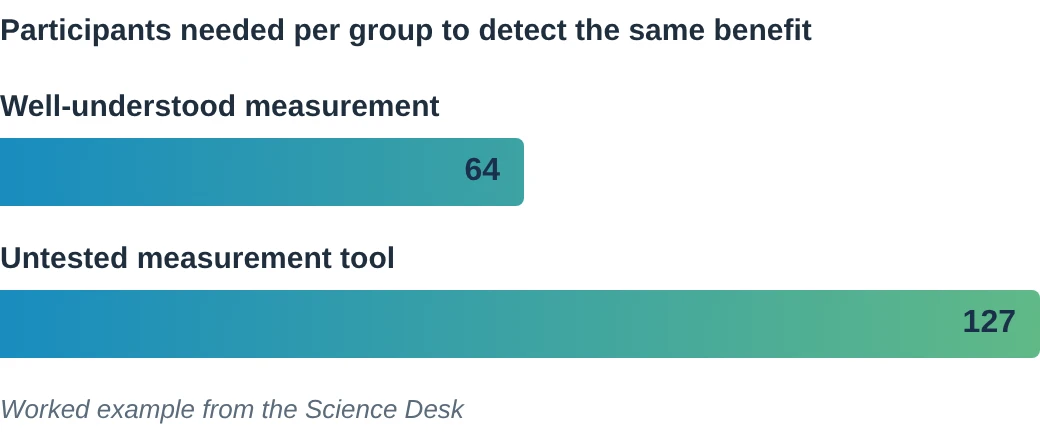
Noise also costs money. Before a trial starts, a detailed power calculation and sensitivity analysis calculates how many participants are needed, and that calculation depends on knowing how much results are likely to vary. Validated tools come with published data on this. Untested ones do not, so the variation they introduce into the sample size calculation is little more than a guess. Suppose your product has a moderate benefit, and a trial with well-understood measurement needs 64 participants per group to detect it. If an untested tool adds as much variation again as already exists between people, and that variation is left out of the calculation, those 64 participants have only about a one-in-two chance of detecting a real benefit. Accounting for it would have required around 127 per group.
Why the cheapest quote can cost the most
Recruiting more participants can compensate for noise, but it is the slowest and most expensive option, and it cannot fix a tool that is consistently inaccurate. This is why the cheapest quote can end up being the most expensive trial. Lower quotes often save on the elements that control noise: in-house questionnaires instead of licensed, validated ones, consumer test kits instead of research laboratories, or a sample size set without a proper power calculation. The saving comes up front. The cost arrives later, as longer timelines, higher recruitment costs or an inconclusive result that cannot support a claim.
Designing noise out from the start
The most cost-effective trial is the one designed to reduce noise from the start. Validated instruments, accredited laboratories and sound statistical design can allow a smaller trial to deliver a clear answer you can take to market, and a clinical trial that stands up to scrutiny.